Research
Co-author, with Professor Paolo Taticchi, of the white paper Cognitive Governance in the AI Era: the foundation of the AI Thinking Quadrants method. Featured in the UCL School of Management news.
Leader Journey
A cognitive-empowerment path for leadership teams: profiling, workshop, plan with HR and individual coaching on real decisions, built on the AI Thinking Quadrants.
Start the conversationHow we make it happen
Cognitive Profiling with DEXISION Readiness 3D: read the person before the technology. Around thirty minutes per manager: a short questionnaire plus eight work situations with AI output. Ten minutes measure what a leader claims; thirty measure what they do.
Speech and reveal of the Cognitive Map. Laboratories on the three cognitive levels (automation, AI-powered analysis, critical thinking), in groups composed by profile.
The mapping is shared with HR and objectives are defined for the next steps.
Two one-to-one sessions for each manager, working on their real decisions with DEXISION Posture Lab.
Without phase one, the day is an event. With phase one, it becomes a method.
Cognitive Profiling
The first move is the Cognitive Profiling, delivered with DEXISION Readiness 3D: a two-part assessment, around thirty minutes, that produces each leader’s readiness profile: the natural posture, the posture to develop, and the discernment observed in performance. On that basis, AI is calibrated to complete the way each manager thinks, not to replicate it.
The Cognitive Map is the aggregated, anonymous photograph of how a leadership team thinks: cognitive gravities, over-used postures, postures that are almost absent.
It is not a psychological assessment, and not a measure of job performance. It does include a task performance measure, narrowed to one thing: how a leader handles AI output that contains a flaw. It is the only non-self-reported input in the model, and it is the one that matters most.
The Reference Archetypes
The behavioural portrait places each leader among five reference archetypes. They are a communicative anchor, an orientation rather than a rigid category, and always come with the full profile detail.
Two axes from the behavioural assessment: how you work (from fast-moving to verifying everything) and how you decide (by instinct or from data). The Ambidextrous sits at the centre by construction. Hover on a profile for the full definition.
| Profile | Distinctive trait | Description |
|---|---|---|
| The Rigorous | Rigour that drives. | Checks everything, trusts data over instinct. |
| The Rapid Explorer | Instinct that explores. | Adopts and decides fast, checks little. |
| The Ambidextrous | Data and instinct together. | Uses both levers; discipline decides whether that is an advantage or a dispersion. |
| The Instinctive | Decides from the gut. | Trusts first impressions, verifies little. |
| The Guardian | Rigour that protects. | Prudent and thorough, adopts little but verifies a lot. |
Archetypes describe disposition: how a leader sees themselves. Whether that rigour actually discriminates is something only the behavioural scenarios can tell. The two readings can diverge, and that is where the readback starts.
From profile to decision
An example: a leader profiled as The Rigorous. Natural position: Critical and Exploratory postures: reasons in depth, anticipates problems, explores alone. Posture to develop: Generative: refines alone and shares drafts late.
In the coaching, the work happens on that leader’s real decisions, supported by DEXISION Posture Lab: the pattern is recognized, and the missing posture is opened at the right moment. The empowerment of reasoning happens on real decisions, not in a classroom.
The AI Thinking Quadrants guide the switch.
Think about how you think: the cognitive profile before the technology. Activate the right posture: the quadrants guide the way of thinking at every moment of the decision. Govern the process, not the contents: AI compensates blind spots and makes reasoning observable and measurable. The framework is detailed on the Cognitive Governance page.
Where the method comes from
The method behind the journey is anchored in an ongoing collaboration with UCL School of Management.
Co-author, with Professor Paolo Taticchi, of the white paper Cognitive Governance in the AI Era: the foundation of the AI Thinking Quadrants method. Featured in the UCL School of Management news.
Affiliated Fellow at UCL School of Management: the research feeds the method applied in companies, and the corporate cases feed the research.
The method is part of the School of Management’s executive programmes for the leadership teams of international industrial groups.
Among the experiences: London Immersion 2026 with Confindustria Umbria →
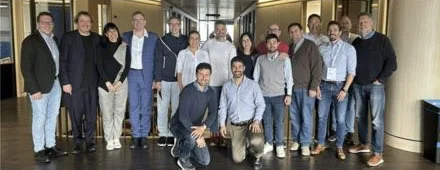
A recent example: three days on innovation and transformation for the leadership team of an international industrial group, with a session dedicated to Cognitive Governance in action: thinking postures applied to the group’s real strategic challenges.
In Italy the method reaches managers through CFMT (Centro di Formazione Management del Terziario), a community of more than 30,000 executives and 10,000 member companies, where Giovanni Giamminola is faculty for masterclasses and courses on AI and management.
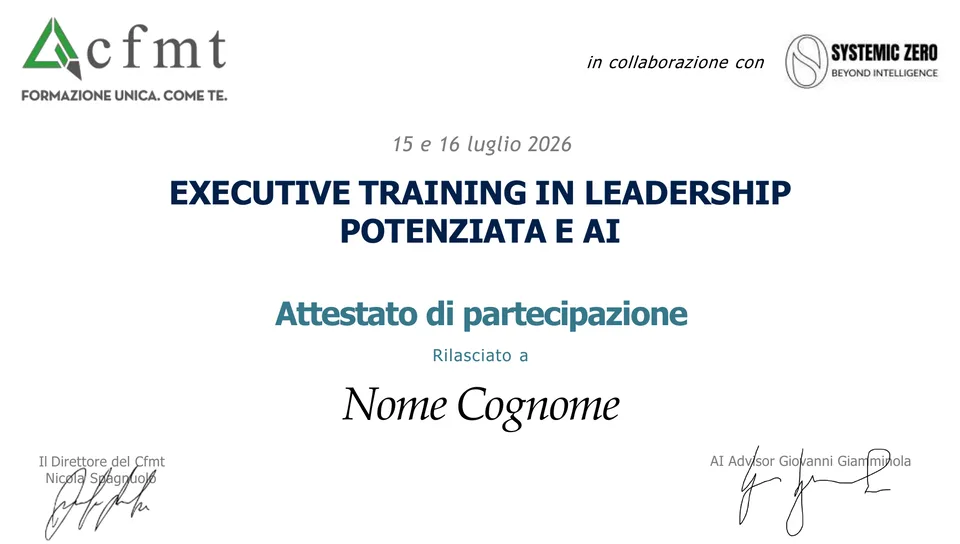
The Milan and Rome masterclass editions were a success: the recap in CFMT’s post on LinkedIn.
Bring it to your leadership team
The journey is designed for executive and leadership teams, together with HR. It begins with the Cognitive Profiling and ends with coaching on real decisions.
Contact us